
 Request FREE consultation - 1866-758-4529
Updated August 2026 | Reviewed by Greg Baumgartner, Texas truck accident lawyer
Texas recorded 39,393 crashes involving commercial motor vehicles in 2024. Those crashes caused 608 deaths and 1,601 suspected serious injuries, according to the Texas Department of Transportation’s final 2024 CMV report. That works out to about 108 commercial vehicle crashes every day.
The numbers are large, but each one represents a driver, passenger, worker, or family. Statistics help show the size of the safety problem. They do not decide fault in a specific wreck.
Greg’s perspective: After more than 40 years handling serious accident cases, Greg Baumgartner has learned that the police report is only the first layer of a truck investigation. The records kept by the driver and company often explain why the crash happened and whether it could have been prevented.
| 2024 Texas CMV measure | Verified total | What the number means |
| Total CMV crashes | 39,393 | About 108 crashes each day |
| Fatal crashes | 546 | More than 10 fatal crashes each week |
| People killed | 608 | More than one death in some fatal crashes |
| Serious-injury crashes | 1,261 | Crashes involving suspected serious harm |
| People seriously injured | 1,601 | Drivers, passengers, workers, and others |
| Harris County CMV crashes | 6,313 | About 16% of the statewide total |
Source: TxDOT, Commercial Motor Vehicle Involved Crashes and Injuries by County, 2024. Reportable crash data were processed as of April 9, 2025.
“Commercial motor vehicle,” “large truck,” “truck involved,” and “fatal truck crash” are not interchangeable terms. TxDOT’s CMV category can include tractor-trailers, buses, delivery vehicles, tow trucks, dump trucks, tankers, and other business-use vehicles. A national large-truck dataset may use a weight-based definition and may exclude buses.
Agencies also count different things. One report may count crashes. Another may count trucks involved. A third may count people killed. The year and definition should appear beside every statistic.
The FMCSA crash-statistics portal warns that 2025 federal crash data remain provisional and can change as reports are added or corrected. TxDOT has also posted a 2025 crash-statistics archive. This page uses 2024 figures, with Texas and national sources treated as final and clearly labeled.
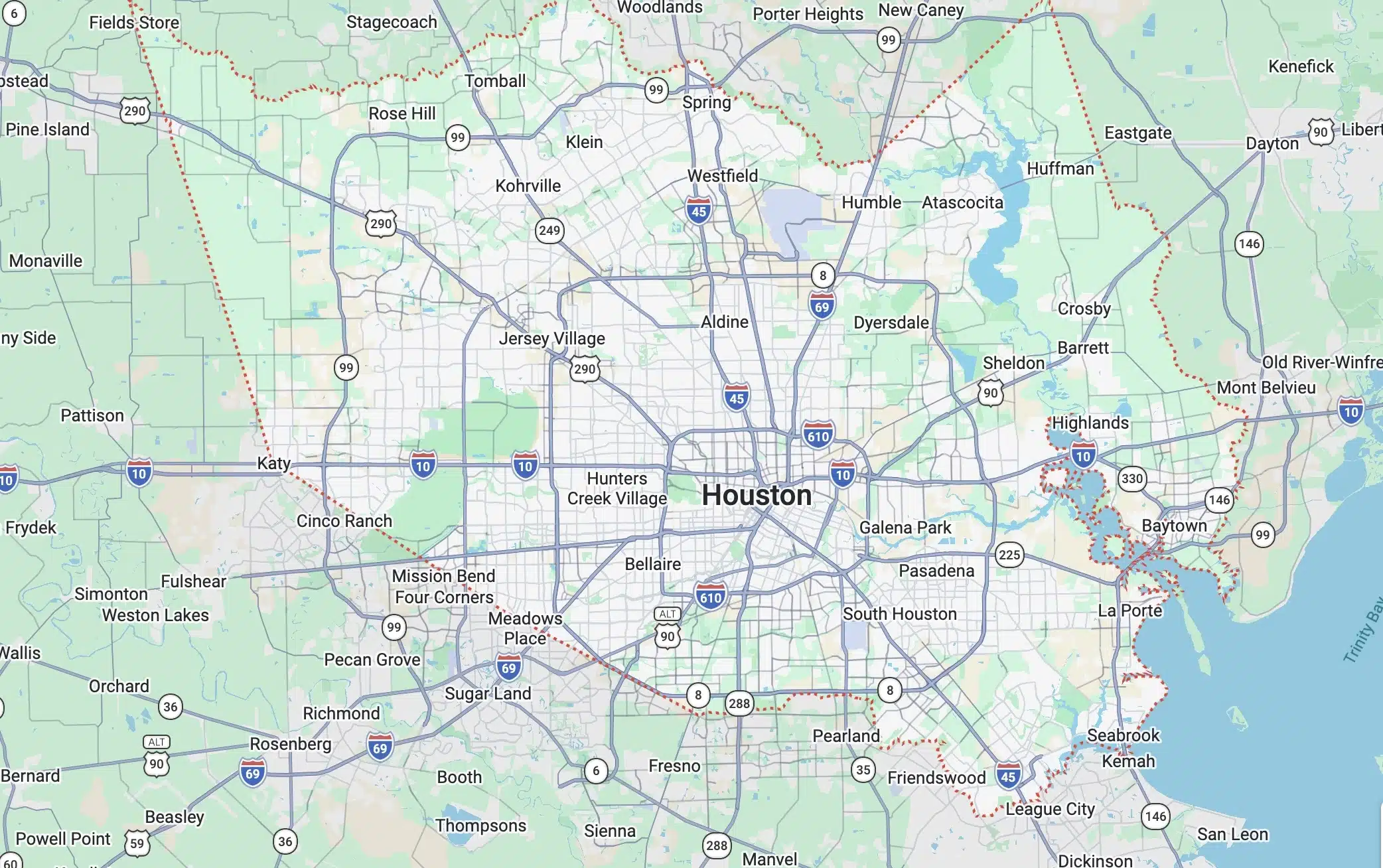
Harris County recorded 6,313 CMV crashes in 2024—about 16% of the statewide total. The county also had 41 fatal CMV crashes, 41 deaths, 98 suspected serious-injury crashes, and 112 people with suspected serious injuries.
The Houston region combines commuter traffic with port, refinery, warehouse, construction, and interstate freight traffic. Trucks and passenger vehicles share complex interchanges and crowded lanes throughout the day. Our guide to Houston highways with the most truck accidents explains the local conditions in more detail.
Two major freight routes are Interstate 10 and Interstate 45. Sudden slowdowns, construction, short merge areas, and high speeds can turn a small driving mistake into a catastrophic collision.
People outside the truck face the greatest danger. The National Safety Council’s 2024 large-truck analysis found that 5,340 people died nationwide in crashes involving large trucks. Occupants of other vehicles made up 70% of those deaths. Truck occupants accounted for 17%, and pedestrians, bicyclists, and other non-occupants made up 13%.
The same source estimated 161,201 injuries in large-truck crashes during 2024. About 72% of the injured people were in other vehicles. A passenger car offers far less protection in a high-speed rear-end, head-on, underride, or rollover collision with a large truck.
These wrecks can cause serious truck accident injuries, including brain injuries, spinal damage, fractures, burns, internal injuries, amputations, and permanent disability.
National 2024 data show that more than half of fatal large-truck crashes occurred on rural roads. About one-quarter occurred on interstate highways. Sixty-two percent happened during daylight, and 5% happened in construction zones.
Rural wrecks can be severe because speeds are often higher and emergency care may be farther away. Urban roads present different risks: congestion, frequent lane changes, short ramps, pedestrians, intersections, and sudden stops.
Texas is a large state with long freight routes, major ports, international trade, energy production, construction, and fast-growing cities. Commercial trucks move through Houston, Dallas-Fort Worth, San Antonio, Austin, the border region, and the Permian Basin every day.
Volume alone does not prove negligence. It does mean that motor carriers must build reliable safety systems for hiring, training, scheduling, inspection, maintenance, and supervision. A company that operates hundreds of trucks cannot treat safety as a paperwork exercise.
A tired driver may react slowly, drift from a lane, miss stopped traffic, or fall asleep. Federal hours-of-service rules generally limit property-carrying drivers to 11 hours of driving after 10 consecutive hours off duty and restrict driving beyond the 14th hour after coming on duty. See the FMCSA hours-of-service summary and our discussion of truck driver fatigue.
A heavy truck needs more room to slow down. Speed that seems manageable on an open road may become unsafe in traffic, rain, a work zone, or a downhill grade. Rear-end crashes often begin when a driver leaves too little space for a sudden stop.
Large trucks have wide blind areas. A rushed or poorly checked lane change can force a smaller car off the road, into another vehicle, or under a trailer.
Worn brakes, damaged tires, steering problems, broken lights, and other defects can turn a preventable problem into a major wreck. Company inspection and repair records often matter when trucking company negligence is investigated.
Overloaded, shifting, or unsecured cargo can contribute to a rollover, jackknife, lost load, or braking failure. The driver, carrier, shipper, or loading contractor may have relevant records and responsibilities.
Motor carriers should verify qualifications, review safety history, provide proper training, and respond to warning signs. Our guide to Texas trucking regulations explains the rules that may apply.
Statewide data cannot prove that a particular driver or company caused a wreck. It can show the broader safety risks that commercial carriers are expected to address. Fault must still be proven with evidence from the actual crash.
That evidence may include the truck’s electronic data, driver logs, dash-camera video, dispatch messages, inspection and repair records, drug and alcohol testing, cargo documents, phone records, driver qualification files, and the carrier’s safety policies.
Important records can be lost or overwritten. Learn what evidence should be preserved after a Texas truck accident and why black-box data can be critical.
Stay visible: Do not remain beside a truck longer than needed. If you cannot see the truck’s mirrors, the driver may not see you.
Leave more space: A truck can block your view of stopped traffic, debris, or a road hazard ahead.
Do not cut in too close in front: The truck may not have enough room to stop if traffic slows.
Expect wide turns: Never squeeze between a turning truck and a curb.
Adjust for conditions: Give trucks more room in rain, high winds, work zones, and heavy traffic.
Move away from danger: Create distance from a truck that is drifting, speeding, losing cargo, or showing a tire or mechanical problem.
TxDOT reported 39,393 crashes involving commercial motor vehicles. That equals about 108 CMV crashes per day.
TxDOT reported 608 deaths in 546 fatal commercial vehicle crashes during 2024.
Harris County recorded 6,313 CMV crashes in 2024, about 16% of the Texas total. The county also recorded 41 deaths and 112 suspected serious injuries.
The sources may use different vehicle definitions, databases, reporting dates, and measures. One may count crashes, another vehicles, and another people killed.
Occupants of other vehicles face the greatest risk. National 2024 data show they accounted for 70% of deaths in large-truck crashes.
No. Statistics show patterns. Negligence must be proven with evidence from the specific driver, truck, motor carrier, roadway, and crash.
TxDOT has posted 2025 state reports, but FMCSA warns that 2025 federal crash data remain provisional. Any 2025 figure should identify its source and status.
Behind every statistic is a person dealing with pain, surgery, missed work, disability, or grief. Greg Baumgartner has represented injured people and families in serious commercial vehicle cases for more than 40 years. His practice is selective, personal, and focused on preserving the evidence needed to hold unsafe drivers and companies accountable.
If you were seriously injured or lost a family member, contact our Texas truck accident law firm or call (281) 893-0760 for a free consultation. There is no attorney fee unless we recover compensation for you.
Texas totals come from TxDOT’s final 2024 Commercial Motor Vehicle Involved Crashes and Injuries by County report. National large-truck figures come from the National Safety Council’s analysis of NHTSA’s Fatality Analysis Reporting System and Crash Report Sampling System. The FMCSA Large Truck and Bus Crash Facts page provides additional federal reporting resources.