 Request FREE consultation - 1866-758-4529
After a serious truck crash, the trucking company’s legal team is already working. Evidence is being secured — or quietly destroyed. The sooner you have experienced legal representation, the stronger your case.
The aftermath of a serious 18-wheeler accident is overwhelming. You may be hospitalized or in shock, but seeking an attorney at this stage is critical.
Trucking companies and their insurers respond right away. After a serious commercial truck accident, their legal team, insurance adjusters, and accident reconstruction experts are quickly mobilized. Their intention: minimize liability before you have representation. They collect evidence and create their narrative—often before you have spoken with an attorney.
An experienced truck accident lawyer immediately protects your interests. They deploy investigators and issue evidence preservation letters to secure vital evidence. Engaging independent experts, your lawyer actively builds your case from the start. Quick action by your lawyer ensures you are not outpaced by the trucking company’s efforts to limit your compensation.
“Do not wait to find the best attorney for your truck accident case. The earlier you retain your lawyer, the better for your case.”
Texas Truck Accident Lawyer – Greg Baumgartner
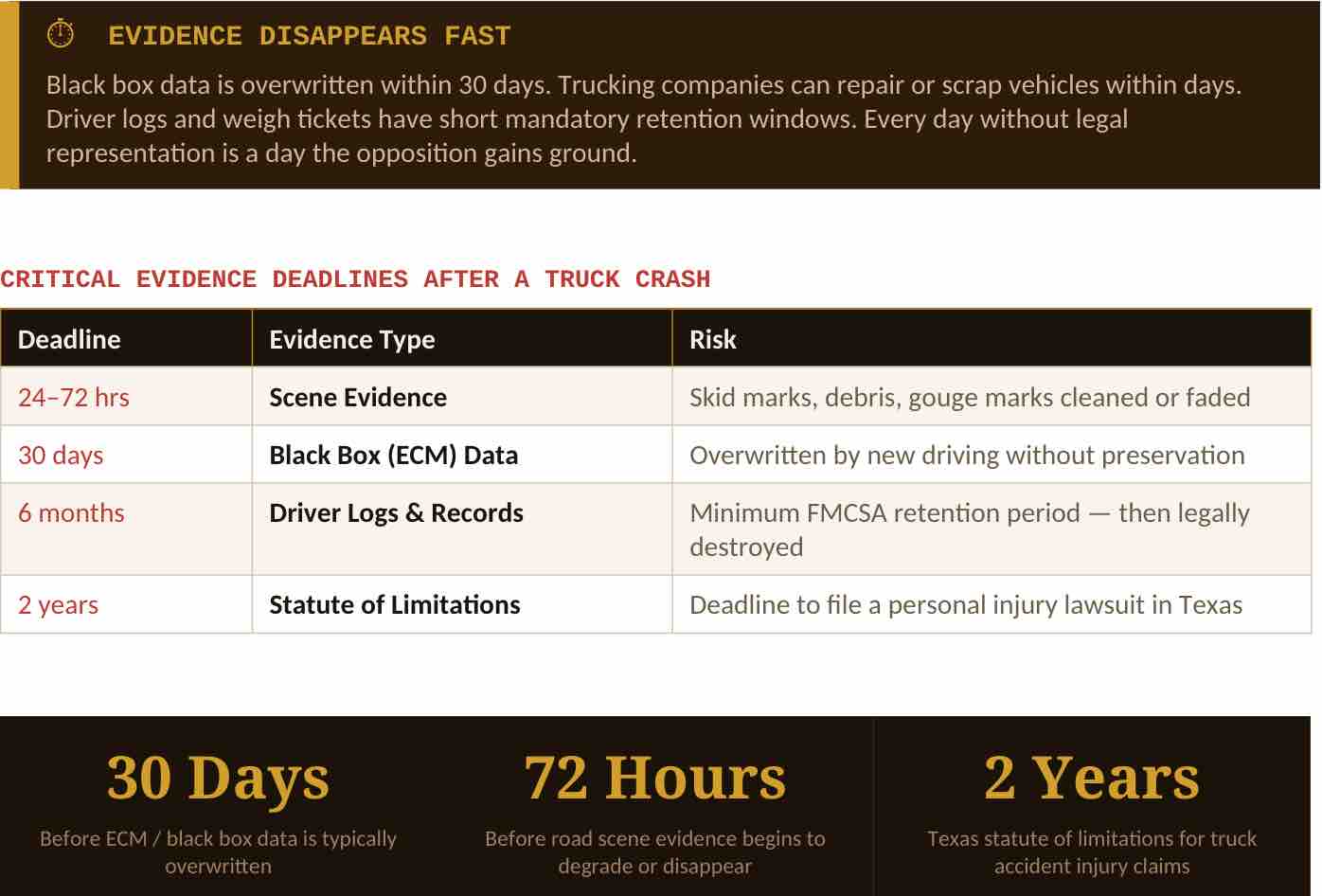
Truck accident cases turn on evidence that is inherently time-sensitive. Unlike a standard car accident, a commercial trucking case involves digital records, regulatory documents, and physical components that are either automatically overwritten, legally destroyed after a set period, or — in the worst cases — deliberately altered to protect the carrier’s interests.
| Accident Scene Evidence | 72 hours | Skid marks, gouge patterns, and debris fields begin degrading immediately. Rain, traffic, and highway maintenance can erase critical physical evidence within hours. Photographs by your attorney’s investigators may be the only permanent record. |
| Black Box Data | 30 days | FMCSA requires carriers to retain logbooks for at least 6 months. After that window, the records may be legally destroyed. Driver fatigue is a leading cause of serious crashes — logs are the primary evidence. |
| The Truck Itself | Days to weeks | Without a formal legal hold, the truck can be repaired, retrofitted, or scrapped — eliminating the ability to inspect brakes, tires, steering, and maintenance records firsthand. |
| Driver Logs & Hours of Service | 6 months | FMCSA requires carriers to retain logbooks for at least 6 months. After that window, the records may be legally destroyed. Driver fatigue is a leading cause of serious crashes — logs are the primary evidence. |
| Vehicle Inspection Reports (DVIRs) | 3 months | Load manifests and weigh tickets establish whether the truck was overloaded. Shippers’ internal retention policies vary, and records can disappear quickly after the delivery cycle closes. |
| Cargo & Weigh Station Records | Varies | Many trucks are equipped with forward- and cab-facing cameras. Nearby business, toll, and traffic camera footage may have captured the crash — all on short overwrite cycles requiring prompt legal action to preserve. |
| Driver Qualification File | Varies | CDL status, prior violations, drug and alcohol testing records, and medical certifications. Central to establishing negligent hiring or retention claims in serious injury and wrongful death cases. |
| Dashcam & Surveillance Footage | Usually 30–90 days | Many trucks carry forward and cab-facing cameras. Nearby business, toll, and traffic camera footage may have captured the crash — all on short overwrite cycles requiring prompt legal action to preserve. |
In a serious truck accident case, your attorney’s first actions are to protect your interests and collect crucial evidence. Acting promptly on these steps can significantly strengthen your case and relieve you of the burden of difficult legal matters.
Many people make the mistake of retaining a general personal injury attorney after a serious 18-wheeler crash. Truck accident cases are a legal specialty, are subject to federal regulations, involve multiple parties with different insurance coverages, and require expertise in commercial vehicle mechanics, cargo law, and FMCSA compliance.
| Standard Car Accident Case Typically involves two parties, one or two insurance policies, straightforward physical evidence, and state traffic law. Most general personal injury attorneys can handle these competently. | 18-Wheeler Truck Accident Case May involve 4–6 parties, multiple insurance policies, federal FMCSA regulations, driver hours-of-service rules, cargo law, commercial vehicle maintenance standards, and specialized electronic data downloads. |
| Evidence in Car Cases Police report, photos, witness statements, and medical records. Most evidence is stable and persists for months. | Evidence in Truck Cases ECM data (overwritten in 30 days), driver logs (destroyed at 6 months), dashcam footage (30–90 days), physical vehicle inspection (days). Time-critical on multiple fronts simultaneously. |
| Damages in Car Cases Medical bills, vehicle repair, lost wages, and pain and suffering. Typically limited by standard auto policy limits. | Damages in Truck Cases Same categories, but with far more severe injuries, commercial truck liability policies up to $5M+, potential punitive damages, and multiple parties contributing to recovery. |
If you or a family member is recovering from serious injuries, choosing the right attorney can help relieve stress, ensure your rights are protected, and improve your chances of receiving fair compensation. Here is what matters most when selecting legal representation for a commercial truck accident case.
You want an attorney with direct personal experience, not one who will delegate important work to junior associates. Retaining a lawyer with expertise in truck accident cases gives you personalized strategies and decisions at every stage.
Settlement offers increase significantly when the insurer knows they are dealing with a lawyer who will actually try the case. An attorney who always settles quickly may not be maximizing your recovery.
If the attorney does not have a clear, immediate plan for preserving ECM data, that is a critical red flag. Any experienced truck accident lawyer should treat this as a priority action on day one.
Understand exactly who handles your case — not just who signs the retainer. Ask about communication policies, how to reach someone in an emergency, and what decisions require your direct input.
One of the most common reasons people delay hiring an attorney after a truck accident is the assumption that they cannot afford legal representation while simultaneously facing medical bills and lost income. This concern shows a misunderstanding of how truck accident cases work financially.
Virtually all serious truck accident attorneys— including our law firm—work on a contingency fee basis. This means you pay no legal fees upfront, making experienced representation available regardless of your financial situation. Your attorney handles case expenses for investigators, experts, and court filings, and collects payment only if you win compensation. If there is no recovery, you owe nothing, ensuring risk-free access to quality legal help.
When a victim is hospitalized or too severely injured to take action themselves, a family member often steps in to find legal representation. This is not only reasonable — it can be the most effective way to ensure that critical evidence is preserved while the victim focuses on recovery.
Preserve Your Own Evidence: Keep all medical records, bills, and treatment notes. Keep a journal documenting the victim’s pain levels, limitations, and recovery progress. Save all communications from the trucking company and insurer. This documentation is important at settlement or trial.
Every day without skilled legal representation is a day that works against you. Call the truck accident attorney in Houston for a no-obligation consultation. Greg Baumgartner will tell you exactly what needs to happen today.
Related Resources: