 Request FREE consultation - 1866-758-4529
Written and legally reviewed by Greg Baumgartner, Texas attorney licensed since 1984
Quick answer: When an 18-wheeler strikes a car that was already stopped in Houston traffic, the central issue is usually why the truck driver failed to recognize the hazard and stop. The truck driver may have followed too closely, looked away, driven too fast for traffic, become fatigued, or operated a truck with unsafe brakes. We investigate the driver, the motor carrier, the tractor and trailer, and the electronic records before key evidence can be overwritten or the truck is returned to service.
A rear-end crash may look simple on a police report. A serious truck case rarely is. The impact can involve an 80,000-pound combination vehicle, several businesses, multiple insurance policies, and electronic systems that record different parts of the trip. The injured person may be taken to the hospital while the trucking company begins protecting itself. Our job is to close that information gap quickly and build the claim from reliable evidence.
Our work in commercial-vehicle cases includes:
Houston drivers regularly encounter sudden slowdowns on I-45, I-10, I-610, US-290, Beltway 8, the Hardy Toll Road, and SH 99. Congestion may form behind a wreck, a work zone, a lane closure, standing water, or ordinary rush-hour traffic. A professional truck driver should scan far enough ahead to recognize those changes and leave enough room to stop without striking the traffic queue. Texas law requires a driver who follows another vehicle to maintain an assured clear distance. The rule appears in Texas Transportation Code Section 545.062.
The physics make that duty critical. Federal highway rules generally set an 80,000-pound gross limit for a typical tractor-trailer operating on the Interstate System. The Federal Motor Carrier Safety Administration guidance on safe speed states that a fully loaded truck at highway speed can need nearly two football fields to stop. That distance grows with speed, wet pavement, worn tires, poor brakes, a downgrade, delayed perception, or a heavy load.
The person in the stopped vehicle has little control over the event. There may be nowhere safe to move when cars fill both sides of the lane. The first impact can push the vehicle into the car ahead, a concrete barrier, or moving traffic. Occupants can experience more than one violent movement within seconds. That is why a crash that begins as a rear impact can cause head trauma, spinal injury, fractures, internal injuries, or death.
A truck driver must leave space for perception, reaction, and braking. A gap that appears adequate in free-flowing traffic can become unsafe when vehicles begin stacking up. FMCSA tells commercial drivers to allow at least 1 second for every 10 feet of vehicle length at speeds below 40 mph, and 1 additional second at speeds above 40 mph. For a typical tractor-trailer, the agency specifies a four-second interval at speeds below 40 mph and a five-second interval at higher speeds. We compare that commercial driver following-distance guidance with actual speed, traffic, weather, grade, and available sight distance.
Following distance is not measured by a slogan after the wreck. We look for video showing the gap, electronic speed records, braking events, witness accounts, roadway measurements, and the position of other vehicles. If the driver had a clear view of stopped traffic but never reduced speed, that evidence can be more important than a broad admission that the truck could not stop in time.
A truck cab can contain a phone, GPS, dispatch tablet, electronic logging device, radio, and fleet-management screen. A driver may look away to read a message, accept a load update, change a route, or handle paperwork. NHTSA notes that reading or sending a text can take a driver’s eyes off the road for five seconds. At 55 mph, that is about the length of a football field. The agency’s distracted-driving safety guidance illustrates how a brief glance can consume the entire distance needed to recognize a stopped queue.
Phone evidence should be requested with care and tied to the time of the crash. Dispatch messages, work-app activity, camera footage, and telematics alerts may be equally important. We do not assume distraction merely because a phone existed. We build a timeline that shows what the driver was doing as traffic slowed.
The posted speed limit does not guarantee that the posted speed is safe. Heavy rain, glare, darkness, road spray, construction, and congested lanes may require a much lower speed. A driver who sees brake lights across several lanes should begin slowing before reaching the last stopped car. In Houston, this issue often matters during sudden freeway backups and heavy rain, when visibility and tire traction fall at the same time.
Fatigue can delay recognition of stopped traffic and slow a driver’s response. Federal hours-of-service rules generally limit a property-carrying driver to 11 hours of driving after 10 consecutive hours off duty and restrict driving beyond the fourteenth consecutive hour after coming on duty. The FMCSA hours-of-service summary provides the current framework. We examine the electronic log, fuel and toll records, dispatch history, trip documents, phone activity, and payroll or time records to see whether the log matches the trip.
A technically compliant log does not always end the inquiry. A driver may be tired because of poor sleep, illness, medication, overnight scheduling, or pressure to complete an unrealistic route. The carrier’s safety practices and dispatch decisions may explain why the driver was still moving when good judgment called for a break.
A driver may claim the brakes failed. That statement should lead to an inspection, not an automatic excuse. We seek maintenance records, repair invoices, driver vehicle inspection reports, roadside inspection history, fault codes, brake measurements, tire condition, and preserved components. Our guide to truck maintenance evidence explains how neglected equipment can connect the driver’s failure to stop with the carrier’s safety decisions.
The tractor and trailer may be owned or maintained by different companies. A repair vendor may have worked on the braking system shortly before the collision. The load may also affect handling and stopping. Bills of lading, weight tickets, cargo records, and trailer information help us determine whether the equipment and load contributed to the impact.
The strongest case usually combines independent sources. One record can be incomplete or misunderstood. Several sources that point in the same direction can show the truck’s speed, the moment danger became visible, the driver’s response, and the carrier’s role.
We treat the phrase black box as shorthand. A commercial truck may have several systems, and no single system records everything. Our detailed guide to black box data after a Texas truck wreck explains why the equipment must be identified before anyone assumes what data exist.
A tractor may be repaired and returned to service. A dash-camera clip may be overwritten. Telematics systems may keep detailed data for only a limited time. A nearby business may routinely delete security video footage. Witnesses become harder to locate, and roadway evidence disappears as traffic and weather change the scene.
A focused preservation notice should identify the evidence tied to the collision. It may cover the tractor and trailer, electronic modules, camera footage, ELD records, GPS and telematics data, dispatch communications, driver files, maintenance records, cargo documents, and post-crash testing. The request should reach every person or company that controls important evidence. Sending a single vague letter to the driver may not protect the records of the motor carrier, truck owner, camera vendor, maintenance contractor, or shipper.
Federal rules require carriers to keep some duty-status records for at least six months, but other data may have shorter practical retention periods. The six-month rule is not a reason to wait. Our broader truck accident evidence preservation guide identifies which evidence may matter and why each category should be evaluated early.
The driver is often the most visible person involved, but the evidence may support claims against other parties. The motor carrier may be responsible for the driver’s work and may also face direct claims based on unsafe hiring, training, supervision, scheduling, maintenance, or safety practices. The tractor owner, trailer owner, maintenance contractor, cargo loader, shipper, broker, or component manufacturer may matter when the facts connect that party to the failure.
We do not name every company on a shipping document merely to make the case look larger. We trace ownership, control, contracts, safety duties, and the specific act that contributed to the crash. That disciplined approach helps keep the case focused and makes the proof easier to explain to an insurer, judge, or jury.
A stopped vehicle is powerful evidence, but rear impact does not eliminate every factual dispute. The trucking company may argue that the car changed lanes directly in front of the truck, stopped without its brake lights working, was involved in an earlier collision, or could not be seen because of weather or darkness. It may claim a sudden emergency, unexpected mechanical failure, or fault by another driver.
We test those defenses against physical evidence. Vehicle damage can show alignment. Video can show the lane history and how long traffic had been stopped. Lamp examination may address a brake-light claim. Electronic data may show whether the driver braked late, braked at all, or approached too fast. Maintenance records can show whether a claimed failure was truly sudden or the result of a known condition.
The defense may also minimize the injuries by pointing to prior neck or back problems, a treatment gap, or modest visible damage to the vehicle. We answer with the medical history, diagnostic studies, treating-provider opinions, photographs, vehicle measurements, and a clear account of how the person’s abilities changed after the collision. Honest proof is stronger than pretending a prior condition never existed.
The rear impact forces the body forward while the seat and restraint system interact with the occupant. A secondary collision may reverse or redirect that movement. Symptoms can be immediate, but some become clearer after the initial shock and adrenaline fade.
Emergency care comes first when there are warning signs such as loss of consciousness, confusion, severe headache, weakness, numbness, breathing difficulty, chest pain, abdominal pain, or worsening symptoms. We encourage clients to describe every affected area accurately and follow the treating doctor’s advice. Medical care should be based on health needs, not on what someone thinks an insurance claim requires.
No honest lawyer can value a serious truck claim from the crash report alone. The value depends on the strength of the liability proof, the injury, medical prognosis, future care, lost income, reduced earning ability, impairment, disfigurement, pain, mental anguish, available insurance, and the effect on the family. A person who returns to work may still have a substantial loss if pain, restrictions, or reduced capacity change the work that can be performed.
We document past losses and future consequences. That work may involve treating physicians, life-care planners, vocational experts, economists, or other qualified professionals. Future damages should rest on evidence rather than a round number.
Texas also follows proportionate responsibility. If the defense proves that an injured person shares responsibility, the recovery may be reduced by that percentage. A claimant found more than 50 percent responsible generally cannot recover. Even in a rear-end case, we preserve the proof needed to answer an effort to shift fault.
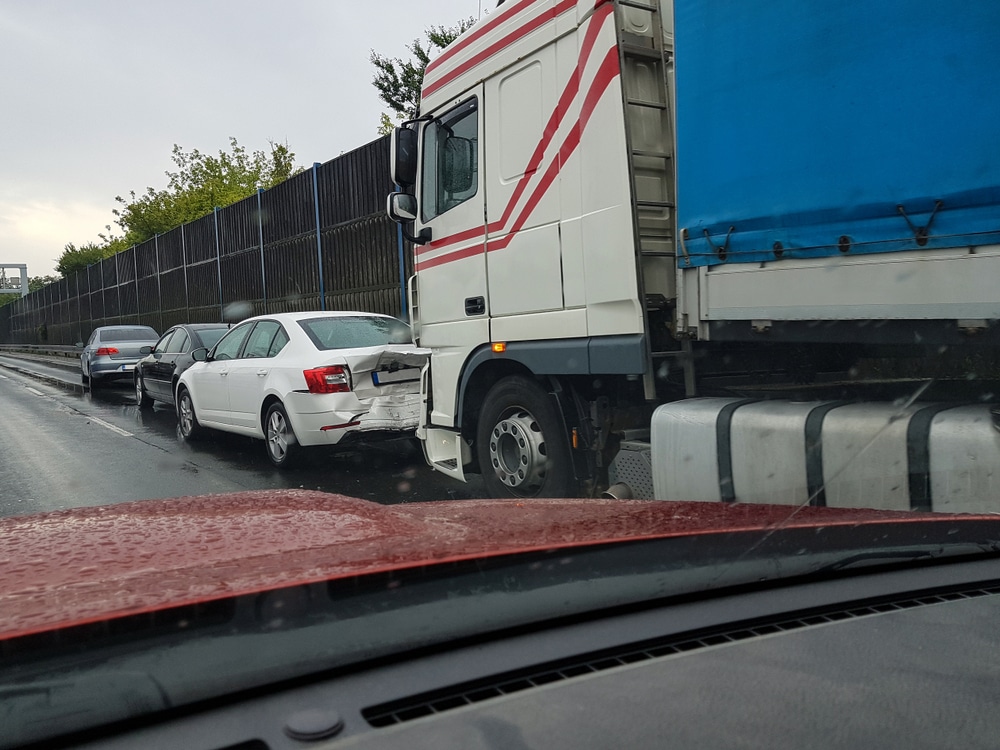
My advice is simple. Take care of your health, do not guess about symptoms, and do not let an adjuster rush you into explaining a crash before the evidence has been collected or the extent of your injuries known. In a serious rear-end truck case, I want to know when the stopped traffic became visible, how fast the truck was moving, when the driver reacted, and what the carrier knew about the driver and equipment. Those facts usually matter.
– Greg Baumgartner
Greg has represented seriously injured people and families in commercial-vehicle cases since 1985. We accept a limited number of serious cases so Greg can remain personally involved in the investigation, case strategy, and preparation. We have never lost a commercial vehicle accident case.
We begin with the collision sequence and the evidence at risk. We identify the driver, motor carrier, tractor owner, trailer owner, maintenance providers, cargo interests, and applicable insurers. We send focused preservation notices, locate available video, obtain the crash report and public carrier information, and determine which electronic systems were installed on the truck.
When the facts require it, we arrange a qualified inspection and download, document the chain of custody, and preserve the raw data. We compare that information with scene measurements, vehicle damage, witness testimony, medical evidence, and carrier records. We also examine hiring, training, supervision, dispatch, hours of service, maintenance, and prior notice of safety problems when those issues connect to the crash.
The goal is not to collect paper for its own sake. The goal is to answer the important points clearly. We establish how long the hazard was visible, how much distance the driver had, whether the truck slowed, why the response came too late, which company decisions contributed, and how the collision changed our client’s life.
The truck driver is often responsible when an 18-wheeler strikes a vehicle that was lawfully stopped in traffic. Fault is still proved with evidence. Video, electronic data, scene facts, vehicle damage, and witness accounts help defeat claims that the car changed lanes, stopped without lights, or created a sudden emergency.
A lack of visible skid marks does not prove that the truck never braked. Anti-lock braking systems may prevent traditional locked-wheel marks. Electronic data, tire marks, roadway evidence, brake-system information, and reconstruction analysis can provide a more complete answer.
The term may refer to several systems rather than one device. Depending on the equipment, data may address speed, throttle, braking, engine activity, sudden deceleration, stability events, fault codes, GPS location, or driver hours. The specific truck and its installed systems must be identified before anyone promises what can be recovered.
An adjuster may request a recorded statement, broad medical authorization, or early settlement. We recommend obtaining legal advice before agreeing. A statement made before the injured person understands the crash evidence or medical outlook can create an avoidable dispute.
Texas generally gives an injured person two years to file a personal injury lawsuit. Different rules or shorter notice requirements can apply in some situations, including claims involving governmental units. Evidence can disappear long before the legal deadline, so the date of the crash and every possible defendant should be reviewed promptly.
If an 18-wheeler rear-ended you or a family member while stopped in Houston traffic, we will listen to what happened, identify the evidence that matters, and explain the next steps. Speak directly with Greg Baumgartner about a serious truck accident claim. Call 281-893-0760 or request a free and confidential consultation. There is no attorney fee unless we recover compensation for you.
Related Resources: