 Request FREE consultation - 1866-758-4529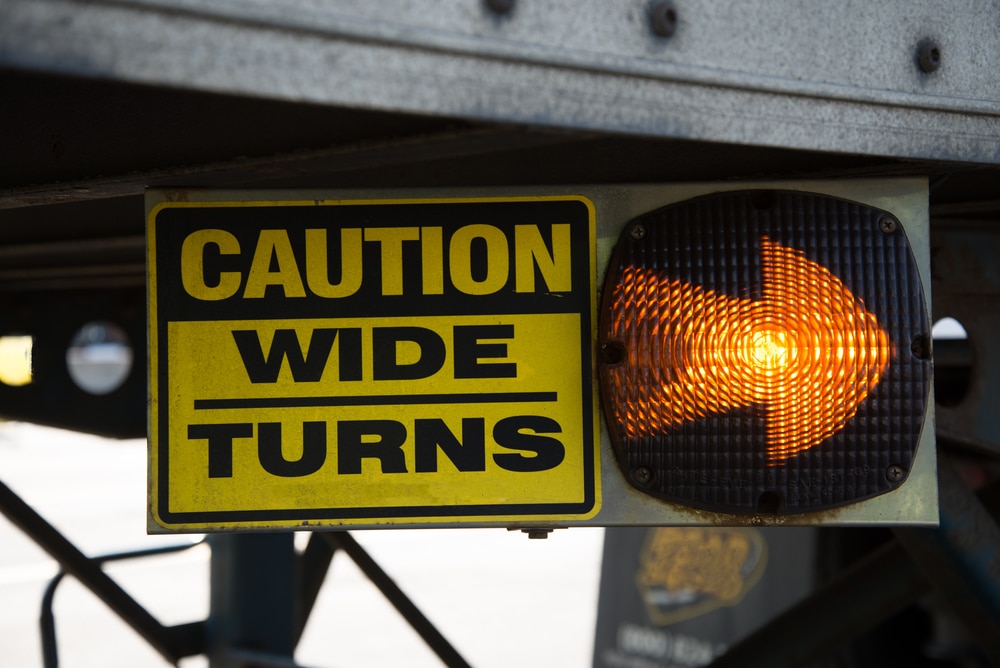
A wide right turn truck accident often happens when an 18-wheeler moves left before turning right, and a car becomes trapped beside the tractor-trailer. The trailer can then move into the car’s lane, sideswipe it, force it onto a curb, or crush it against another vehicle or object.
These crashes are sometimes called squeeze-play accidents.
Determining fault is not always as simple as looking at where the vehicles ended up. The important questions usually involve where the truck started its turn, whether the driver signaled, what the driver could see in the mirrors, whether another vehicle was already beside the truck, and whether the truck driver kept a proper lookout throughout the maneuver.
After more than 40 years of handling serious commercial vehicle cases, we have learned that the evidence from the few seconds before a wide-turn collision can be more important than the point of impact itself.
A tractor-trailer cannot turn like a passenger car.
When the tractor turns, the trailer’s rear wheels do not follow exactly the same path as the tractor’s front wheels. The trailer tracks farther into the turn. A driver may therefore need additional room to complete a right turn without running the trailer over a curb, striking a sign, or hitting another vehicle.
The Federal Motor Carrier Safety Administration warns motorists that trucks need extra space and time to make wide turns and may initially move left before making a right turn.
That does not mean a truck driver has permission to ignore traffic beside the truck.
Commercial drivers still must plan the maneuver, signal their intentions, use their mirrors, watch surrounding traffic, control their speed, and make sure the turn can be completed safely.
FMCSA guidance on safely driving around large trucks
A squeeze play happens when a vehicle becomes caught between a turning tractor-trailer and the curb, another lane, a guardrail, or another object.
A common scenario looks like this:
1. An 18-wheeler approaches an intersection intending to turn right.
2. The truck moves somewhat left to create additional turning room.
3. A passenger vehicle is already beside the truck or enters the space on its right.
4. The truck begins turning right.
5. The trailer tracks inward and strikes or traps the passenger vehicle.
The consequences can be severe because the occupants of the smaller vehicle may have nowhere to escape.
One problem we look for in these cases is whether the truck’s movement created what appeared to be an open traffic lane. We also want to know whether the driver checked the right-side mirrors before and during the turn.
A truck driver cannot simply begin a maneuver and stop monitoring the traffic around the trailer.
Fault depends on how the collision happened. A truck driver may be primarily responsible, another motorist may share responsibility, or the evidence may show negligence by both.
Evidence of truck-driver negligence may include:
The FMCSA specifically advises commercial drivers to frequently check blind spots and to make wide turns carefully.
FMCSA safety tips for truck and bus drivers
Yes. That argument is common.
A trucking company or its insurer may claim that the other motorist drove into a visible turning truck’s path, attempted to pass the truck on the right, was speeding, or failed to react to an obvious turn signal.
That does not automatically make the argument correct.
The physical evidence must be compared with what each driver actually did.
For example, there is an important difference between a driver who races around a truck already making an obvious right turn and a motorist who was lawfully traveling beside a truck when the truck suddenly moved into the motorist’s lane.
Texas uses a proportionate-responsibility system. A person’s recovery can be reduced by their percentage of responsibility, and a claimant generally cannot recover if found more than 50% responsible.
That makes an accurate investigation especially important when the trucking company’s insurer tries to shift blame.
Texas Transportation Code § 545.101 states that a driver making a right turn at an intersection generally must make the approach and turn as closely as practicable to the right-hand curb or edge of the roadway.
Read Texas Transportation Code § 545.101
Large commercial trucks pose practical turning challenges due to their length and trailer tracking. The question in a truck accident case is therefore rarely answered merely by saying, “The truck had to make a wide turn.”
The better questions are:
Those facts can determine whether the turn was performed safely and reasonably.
A serious truck accident investigation should not stop with the person behind the wheel.
Depending on the circumstances, evidence involving the trucking company may also matter. For example, we may investigate whether the company properly selected, qualified, supervised, and trained the driver.
Wide-turn accidents can be particularly relevant to training because safely maneuvering a tractor-trailer through intersections is a basic commercial driving skill.
Our discussion of improper truck driver training claims explains why a driver’s experience and training history can become important after a serious crash.
You can also read more about who may be responsible for a truck accident.
| Greg Baumgartner’s Perspective. In a wide-turn truck case, I want to reconstruct the few seconds leading up to impact. The damage to the vehicles tells us something, but it rarely tells the whole story. I want to know where the tractor was, where the trailer was, where the other vehicle was, when the turn signal came on, what the driver could see in the mirrors, and whether the truck’s movement created an opening that another driver could reasonably believe was a travel lane. |
Evidence worth preserving can include:
Video can be especially powerful.
A camera may establish where both vehicles were before the collision and can sometimes resolve arguments about whether the car attempted to pass the truck or whether the truck moved into a lane already occupied by the car.
This is one reason we encourage people seriously injured in a commercial truck accident to investigate the crash promptly.
Being in an area that is difficult for a truck driver to see does not, in itself, establish fault.
Commercial drivers know – or should know – that tractor-trailers have substantial blind spots. Managing those blind spots is part of safely operating the vehicle.
FMCSA describes inadequate surveillance as a situation in which a commercial driver fails to look where necessary to complete a maneuver safely or looks but fails to see approaching traffic.
The key question is not simply whether the passenger vehicle was near a blind spot.
The question is how both vehicles got there and what each driver reasonably should have done before the collision.
Squeeze-play collisions can be especially dangerous because the impact often occurs on the passenger vehicle’s side, where there is less structural protection between an occupant and the truck.
Serious injuries can include:
Rather than assuming an injury is minor based on vehicle appearance, the medical evidence should determine the seriousness of the injury.
If possible:
1. Call the police.
2. Photograph the truck, trailer, passenger vehicle, lanes, traffic signals, and intersection.
3. Get contact information from witnesses.
4. Seek appropriate medical treatment.
5. Do not give a recorded statement about fault to the trucking company’s insurer without understanding your rights.
6. Identify nearby businesses or homes that may have surveillance cameras.
7. Preserve photographs, videos, dashcam footage, and documents from the crash.
Surveillance footage can disappear quickly because many systems automatically overwrite older recordings.
The truck driver may be at fault if the driver failed to signal, check mirrors, maintain a proper lookout, control the turn, or account for a vehicle already beside the truck. Fault depends on the evidence from the particular accident.
A tractor-trailer may need additional room to safely negotiate a right turn, but the need for additional space does not eliminate the driver’s responsibility to watch surrounding traffic and perform the maneuver safely.
A squeeze-play accident occurs when a vehicle becomes trapped beside a turning truck as the trailer tracks toward the inside of the turn.
Possibly, depending on the circumstances. The trucking company may argue that you attempted to pass an obviously turning truck. But if you were already lawfully beside the truck when it moved into your lane, the evidence may tell a very different story.
Video, photographs, vehicle damage, witness testimony, truck camera footage, electronic data, driver records, training records, and evidence showing the location of both vehicles immediately before impact can be important.
Potentially. Depending on the facts, a trucking company may face responsibility for its driver’s conduct and, in appropriate cases, for issues involving hiring, qualification, training, supervision, or company safety practices.
Wide-turn truck crashes can look straightforward until the insurance company begins arguing about who entered whose lane.
That is why preserving evidence early matters.
If you or a family member suffered a serious injury in a wide-turn collision with an 18-wheeler or commercial truck, contact our Texas truck accident lawyer for a free consultation.
Call (281) 893-0760.
There is no attorney’s fee unless we successfully resolve your case.
Related Resources:
How Can I Protect My Rights After a Truck Accident?
Wide and oversize loads in Texas
How to Determine Fault in a Blind Spot Accident